Taking the High-Speed Train (HSR)
China's high-speed rail is fast and punctual. What catches foreigners out is the station process: two security checks, passport-based ticketing, and boarding that can close before the printed departure time.
Last verified 16 October 2026. Checked against: Our own testing. Alcohol rule from owner experience, 16 October 2026.
Find your train on the main hall board
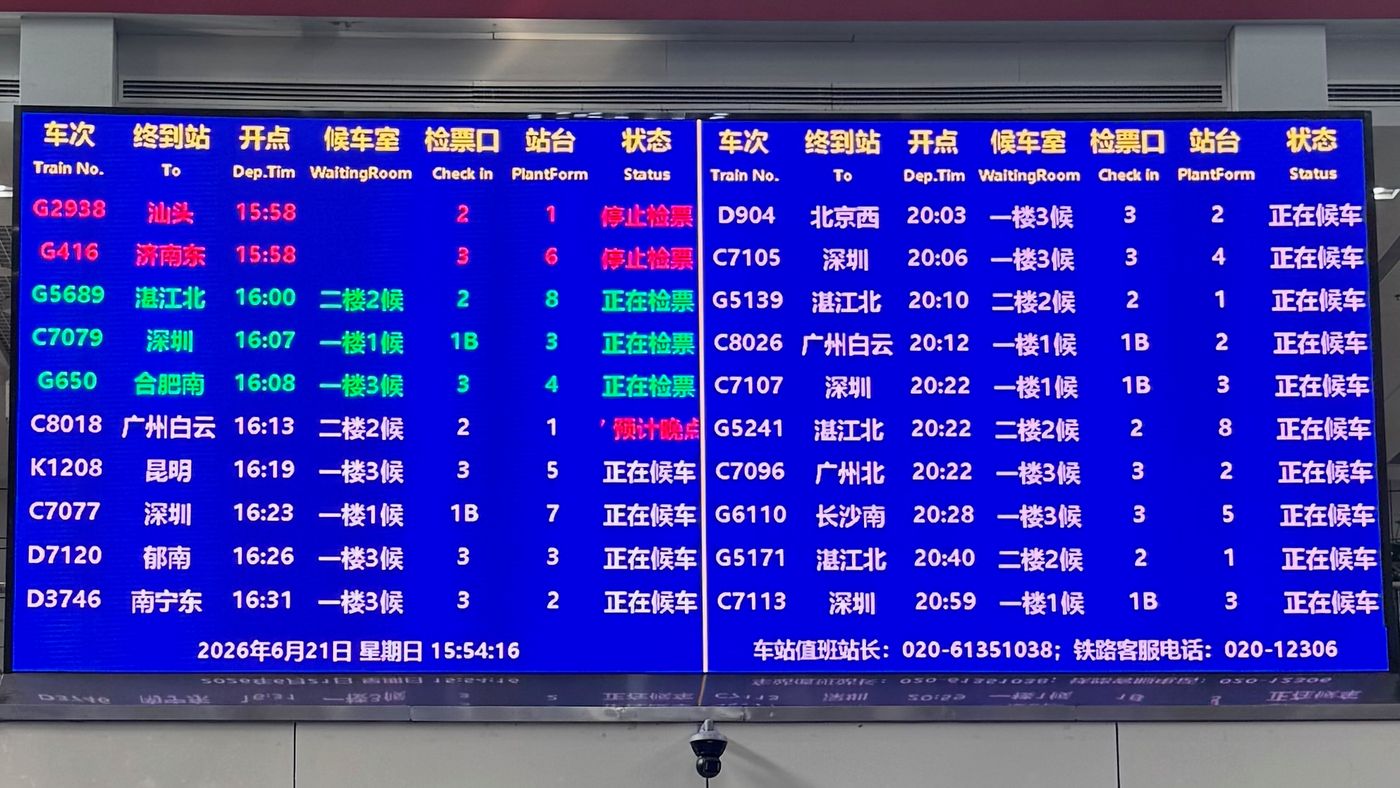
The first board you see. Find your train number, note the platform and colour — the gate board later is the same skill, one level closer.
Details
In the main departure hall, find the large board and look for your train number, e.g. G5689 — not a gate letter, the way an airport works.
This board is bilingual at major stations, with small English printed under each Chinese header. Left to right: 车次 / Train No. (your train number), 终到站 / To (destination), 开点 / Dep.Tim (scheduled departure), 候车室 / WaitingRoom (which waiting room to go to), 检票口 / Check in (the gate number — same meaning as the gate board), 站台 / PlantForm (platform), and 状态 / Status.
The Status column is colour-coded, and the colour tells you the whole story at a glance before you even read the characters: white rows reading 正在候车 mean Waiting — boarding has not started yet. Green rows reading 正在检票 mean Boarding — the gate is open, move now. Pink or red rows reading 停止检票 mean Boarding closed — if you are not through, you have missed it. A lighter red or pink row reading 预计晚点 means Delayed.
You can tell at a glance whether a train on the board is even still reachable before you find your own row — skip anything already showing 停止检票 in red.
Read the gate board: everything you need, on one screen
Train number → From/To/Departure match your ticket → Platform → Marking colour → Status.
Details
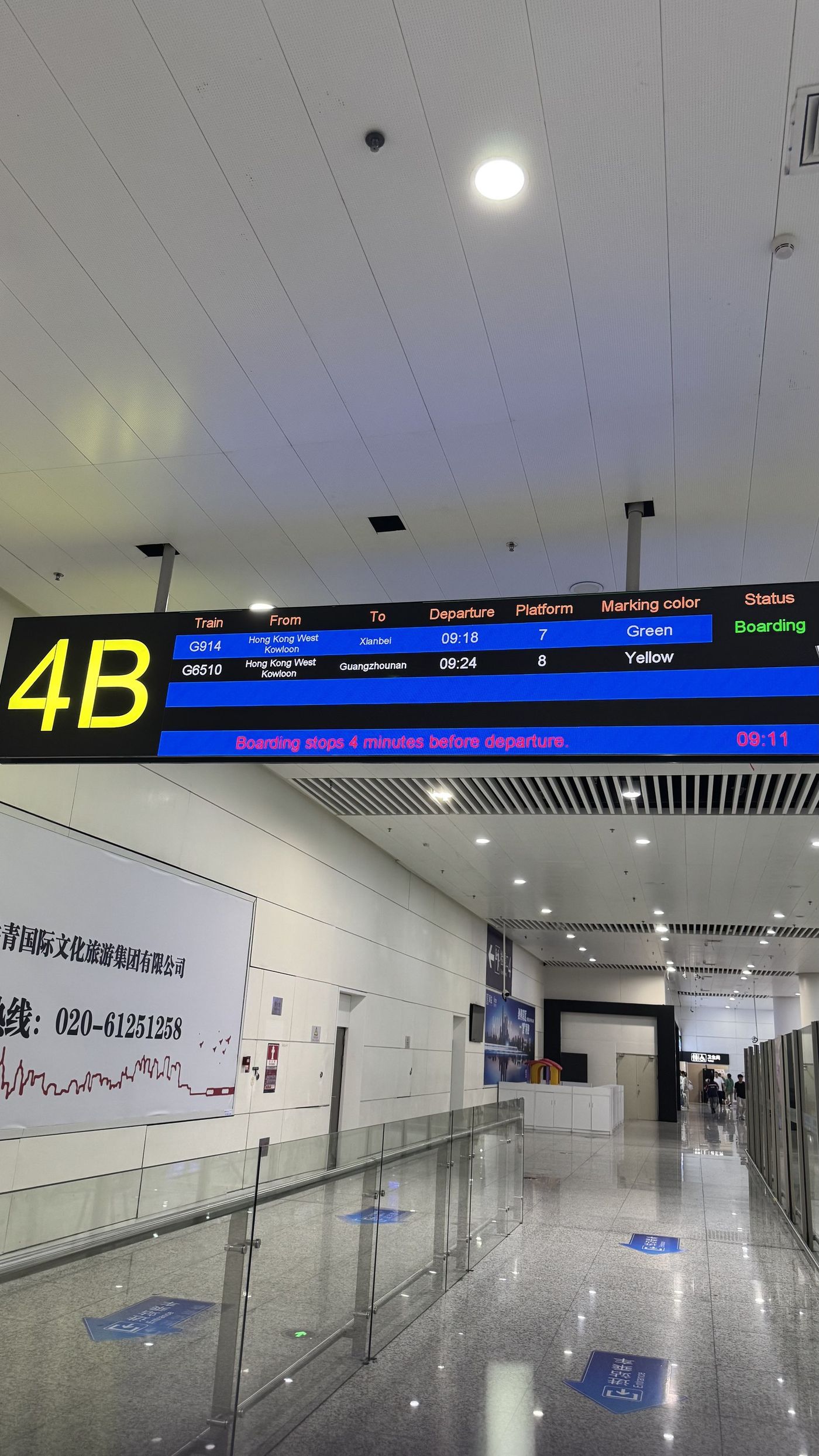
This is the board directly above your boarding gate. Major stations display it in English or bilingually; smaller stations may show Chinese only, but the layout is the same everywhere.
The big yellow number on the left is your gate — where you queue and where staff check your passport. It is not your platform and not your train number. One gate serves two platforms: on a typical board, one train feeds platform 7 and another feeds platform 8, so getting to the right gate is only half the job — check which platform your train is on before you go through.
How to use it: find your train number in column one (车次), read across the row, confirm From (始发站), To (终点站), and Departure (开车时间) all match your ticket, note the Platform (站台) and Marking colour (检票口颜色), then check the Status (状态).
Marking colour is the column everyone ignores — it tells you roughly where your carriage will stop. Walk to your colour zone rather than boarding the nearest door and dragging a suitcase through five carriages.

- 1Gate number — where you queue
- 2Train number — start here
- 3From — confirms the service
- 4To — confirms direction
- 5Departure — must match your ticket
- 6Platform — one gate serves two
- 7Marking colour — where to stand
- 8Status — boarding state
- 9The real deadline — read this every time
Reading the status column
停止检票 (tíng zhǐ jiǎn piào, "boarding closed") is your real deadline, not the departure time.
Details
Every train cycles 正在候车 (Waiting) → 正在检票 (Boarding) → 停止检票 (Boarding closed). A delay notice, 预计晚点 (Delayed), overlays this without replacing it.
停止检票 is your deadline — not the departure time.
Before you travel: booking
Trip.com when sold out (waitlists); 12306 for the official system, set up early.
Details
Trip.com handles passport registration for you, issues tickets in English, and charges a small booking fee. Its real advantage is that it can put you on a waiting list and sell outside the standard release window, so it is the better option when a route looks sold out.
12306 is the official Chinese rail system with an English app and website, but foreign passport registration inside it is genuinely clunky — set it up well before your trip. It generally sells only what is actually available.
Book early on popular routes: Shanghai–Beijing, and anything through Chengdu in peak season, sell out common departure times days ahead. Your passport is your ticket — some stations print paper tickets from self-service machines, but the passport scan is what gets you through the gates.
Station entry and first security check
Staffed line, not automated gates. Arrive 45-60 min early on a first trip.
Details
Show passport and ticket at the station entrance. Foreigners cannot use the automated ID-scan gates — use the manual, staffed line. At a busy station expect 10 to 15 minutes, plus a bag scan.
Arrive 45 to 60 minutes early on a first trip — station navigation takes longer than the walking distance suggests.
Alcohol and liquids at security
Alcohol at 20% ABV or above is confiscated, even unopened. Pack it in checked luggage or leave it behind.
Details
At security, alcohol at 20% ABV or above is confiscated, even if it is unopened. Staff may also ask you to drink or pour out your liquids on the spot.
Go to your gate and read the gate board
Same board, same rules — now above your actual queue.
Details
The gate board sits above the queuing area so you can read it while you wait. Everything in the gate board section above applies here.
Through the gate
In the waiting hall, past security, 20 minutes before departure — trains can leave early.
Details
The rule: be in the waiting hall, already through entry ID-check and bag scan, 20 minutes before scheduled departure. This is a flat rule, not a per-station calculation — gates open anywhere from 10 to 20 minutes before departure depending on station and platform distance.
The 20 minutes counts from the waiting hall, not the station entrance — at a large terminal with a manual foreigner line at entry that can itself run 10 to 15 minutes, arriving at the front door 20 minutes before departure is not the same as being in the waiting hall 20 minutes before. Budget for entry and security separately, then add the 20-minute gate buffer on top.
Boarding itself closes asymmetrically: it typically opens 10 to 20 minutes before departure and closes 3 to 10 minutes before, a shorter and more variable window. This is your second manual passport check.
Trains can leave before the scheduled time — confirmed firsthand, a train departed 2 minutes early once all passengers were aboard. Treat 停止检票 as the actual cutoff, never the printed clock time.
Follow the corridor to your platform
Follow the numbered platform signs, not the crowd.
Details
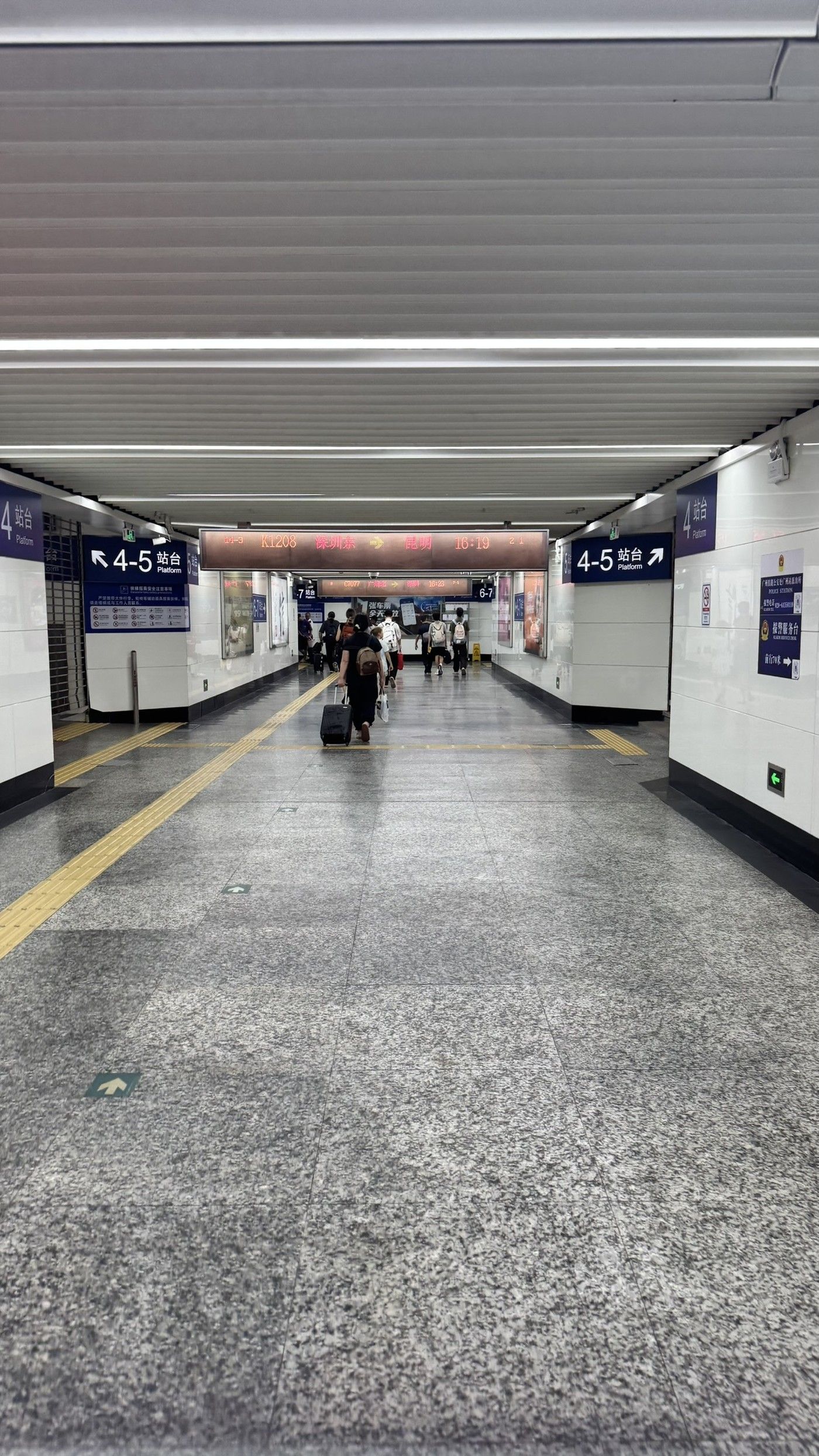
Past the gate, you'll typically walk through an underground corridor toward your specific platform, marked by bilingual signage. A small overhead screen along the way often reconfirms your train number, destination, and departure time. Follow the numbered platform signs rather than the crowd — groups head to different platforms from the same corridor.
Find your carriage
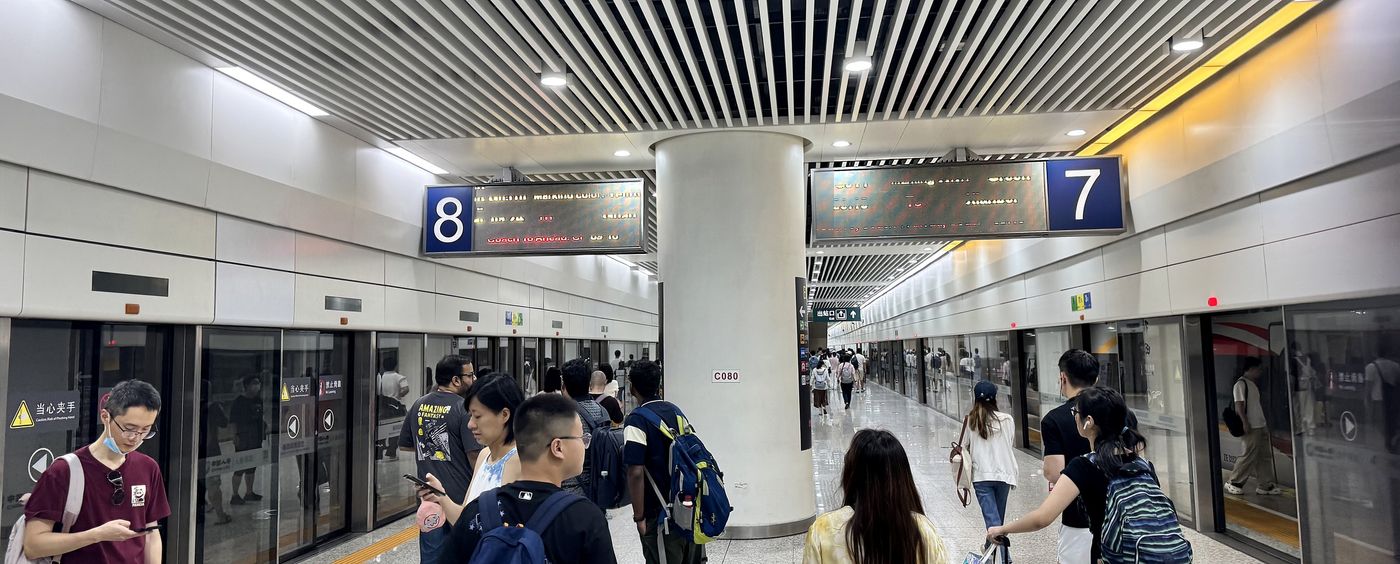
Simple version: the screen shows a colour — walk to that colour zone for your carriage.
Details
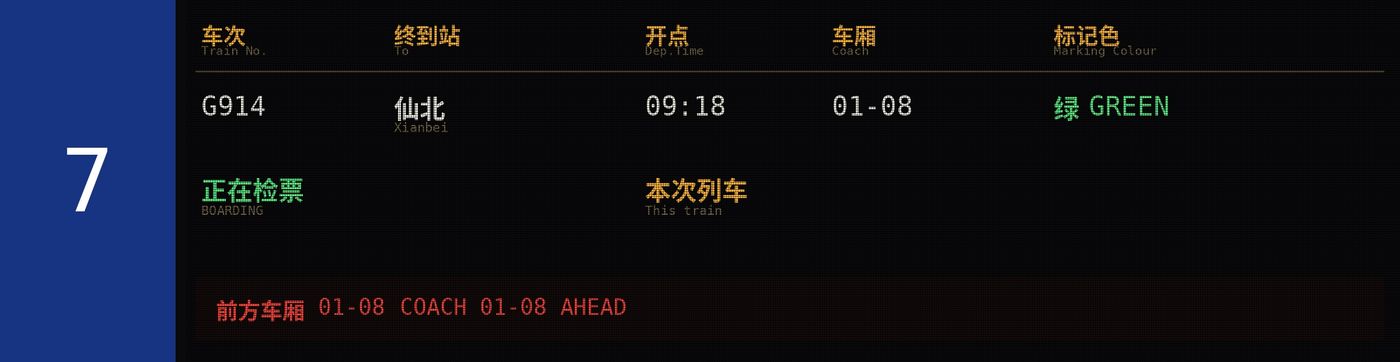
The platform floor is divided into colour-marked zones, and a dot-matrix readout above the platform tells you which colour and which carriage range is yours for the train that is boarding right now. That is the whole system: match the colour on the screen to the colour zone on the floor, and you are standing in roughly the right spot before the train arrives.
Above each platform number sits this readout, repeating the live train information one level closer to where you board. The scrolling red message along the bottom usually tells you which coaches are ahead of your current position, e.g. 前方车厢 01-08 / COACH 01-08 AHEAD — use it to work out whether to walk forward or back along the platform.
Your ticket shows carriage (车厢) and seat (座位). If you noted the marking colour from the gate board earlier, this is where it pays off — walk to that colour zone before the train arrives, rather than boarding the nearest door and dragging a suitcase through five carriages.
Quick reference
| Route looks sold out | Trip.com, it waitlists and sells outside the standard window |
| Want the official system | 12306, but register your passport well before the trip |
| Finding your train | Train number first, e.g. G914, never a gate letter |
| Confirming it is the right train | From, To and Departure all match your ticket |
| Where to queue | Gate number, the big yellow number on the gate board |
| Which platform | Platform column, one gate serves two |
| Where to stand on the platform | Marking colour column |
| Your actual deadline | The red line on the board, and 停止检票 status |
| Gate timing | Be in the waiting hall, past security, 20 minutes before departure |
| Automated ID gates | Do not use them, staffed line, twice |
| Carrying alcohol | Checked luggage or leave it behind. Confiscated at security at 20% ABV or above |
Useful phrases
正在候车
Waiting
正在检票
Boarding
停止检票
Boarding closed
预计晚点
Delayed
护照
Passport
Common questions
Can foreigners buy high-speed train tickets in China?
Yes. Trip.com registers your passport for you, issues tickets in English for a small booking fee, and can put you on a waiting list when a route looks sold out. 12306 is the official system, with an English app and website, but passport registration there is clunky, so set it up well before your trip.
Do I need my passport to board?
Yes. Your passport is your ticket. Foreigners use the staffed line, not the automated ID gates, at the station entrance and again at the boarding gate.
Why can boarding close before the printed departure time?
Boarding stops some minutes before departure, and each station posts its own cutoff on the gate board. Treat the status 停止检票 (boarding closed) as your real deadline. Trains can even leave a little early once everyone is aboard.
Related guides
- NextSetting Up the Metro QR CodeChinese metro systems run on QR codes, not tickets or cards. Activate a transit QR inside WeChat, then hold your phone to the gantry scanner to enter and exit — fares charge automatically.
- NextStaying connected: eSIM first, VPN as backupGoogle, WhatsApp, Instagram and YouTube are blocked in China. A travel eSIM on your phone is the sure bet and needs no VPN. Add a VPN for your laptop as backup, and set both up before you leave home.
- NextBefore you fly: your China checklistSix quick checks before you land in China, in order. Tick them off as you go: texts, payments, eSIM, power banks, the border and the train.
Get the Dao companion when it launches in Shenzhen
Send this guide to your travel partner
Apps, fees and station rules change. These guides reflect our testing on the date shown.
← Back to Guides